Uganda Travel Blog
Uganda 2026 – A Beginning (Anthony · Flavian · Vitus) At the end of January 2026, we officially launched our first independently implemented project on the African continent. It had all started months earlier—with video calls, Excel spreadsheets, discussions about customs formalities, and countless coordination efforts across time zones.
But all that preparation came to a head in that moment: the first step on Ugandan soil.
Unser Ziel: die Installation eines PAUL-Wasserfilters.
A system that can filter several thousand liters of water per day using ultra-thin membrane fibers and pure gravity—a system that requires no electricity or chemicals, yet removes bacteria, viruses, and other pathogens almost entirely from contaminated water (on average, up to 99.99999%).
All of the donations received for this purpose were used entirely to purchase the filter and to fund the necessary on-site construction work. We covered travel expenses, accommodation, and all organizational costs out of our own pockets. Transparency was important to us from the very beginning.
Here in Uganda, contaminated water regularly leads to gastrointestinal illnesses, cholera, or typhoid. Brother Herman, the principal of St. Balikuddembe Primary School in Buwama, explained to us that many children therefore miss school—not because they lack motivation, but because they are sick, particularly due to the overall inadequacy of the health and sanitation infrastructure.
But technology alone doesn’t make much of a difference. What matters is where it’s used—and how. How is it connected? Who takes responsibility? Who oversees maintenance and flow? How is long-term use ensured? It was precisely these questions that we learned to ask and discuss together during many conversations before the trip—and especially during it. A filter is only sustainable if it becomes part of a functioning system.
The fact that our first project took place in Uganda was no coincidence—it was the result of relationships that had developed over time. Through our exchanges with Dr. Kreikebaum, a lecturer at EBS University—whom we would like to sincerely thank for his support—as well as through his existing local contacts, we were ultimately able to establish a connection with St. Balikuddembe Primary School in Buwama.
Before Vitus and I visited the school for the first time, our journey took us first to Makerere University in Kampala.
The plan had been for a brief introductory meeting. Instead, a few minutes later we found ourselves sitting in the conference room—across from the dean, the president, and other university stakeholders.
It was a lengthy conversation filled with many encouraging words. At the same time, I still found it difficult to imagine how these ideas could be translated into concrete actions step by step—so that we could achieve our goals together and sustainably. Yet the typically African, laid-back confidence was contagious.
Buwama is located about two and a half hours southwest of Kampala. Red earth, small market stalls, motorcycles, children on the side of the road.
There, we were greeted by Brother Herman, the principal. 917 students attend the public elementary school. Officially, the new school year began on February 2. However, the start of the new school year was postponed to the 10th due to the presidential elections—which meant we had to leave the school before the regular start date. So we didn’t get to experience the large crowd of children. And yet some were there—including children who no longer have parents, or children whose parents cannot care for them during the day. For them, school is not just a place of learning, but a living space. It is in moments like these, if not before, that one understands that water is more than just hygiene. It is stability.
What really struck us from the very beginning was how natural the openness felt. Within just a few hours, many of our encounters didn’t feel like we were meeting for the first time, but rather like we were reuniting.
Gemeinsam mit Brother Herman, Vincent – inzwischen enger Partner unseres Vereins und Freund -, Kole, Medizinstudent, und Derrick, Business-Student an der Makerere University, sowie unserem Fahrer Isaac standen wir stundenlang auf dem Schulgelände.
We drew sketches, discussed pressure conditions, and considered water flow.
One of the first lessons learned on site: The many hours of strategic planning via Teams were valuable—but reality had its own rules.
The starting point was the school’s existing water situation: a small faucet connected to larger tanks, supplied by a mixture of collected rainwater that had been sitting for some time and the unreliable municipal water supply. The supply fluctuated in terms of both pressure and water quality.
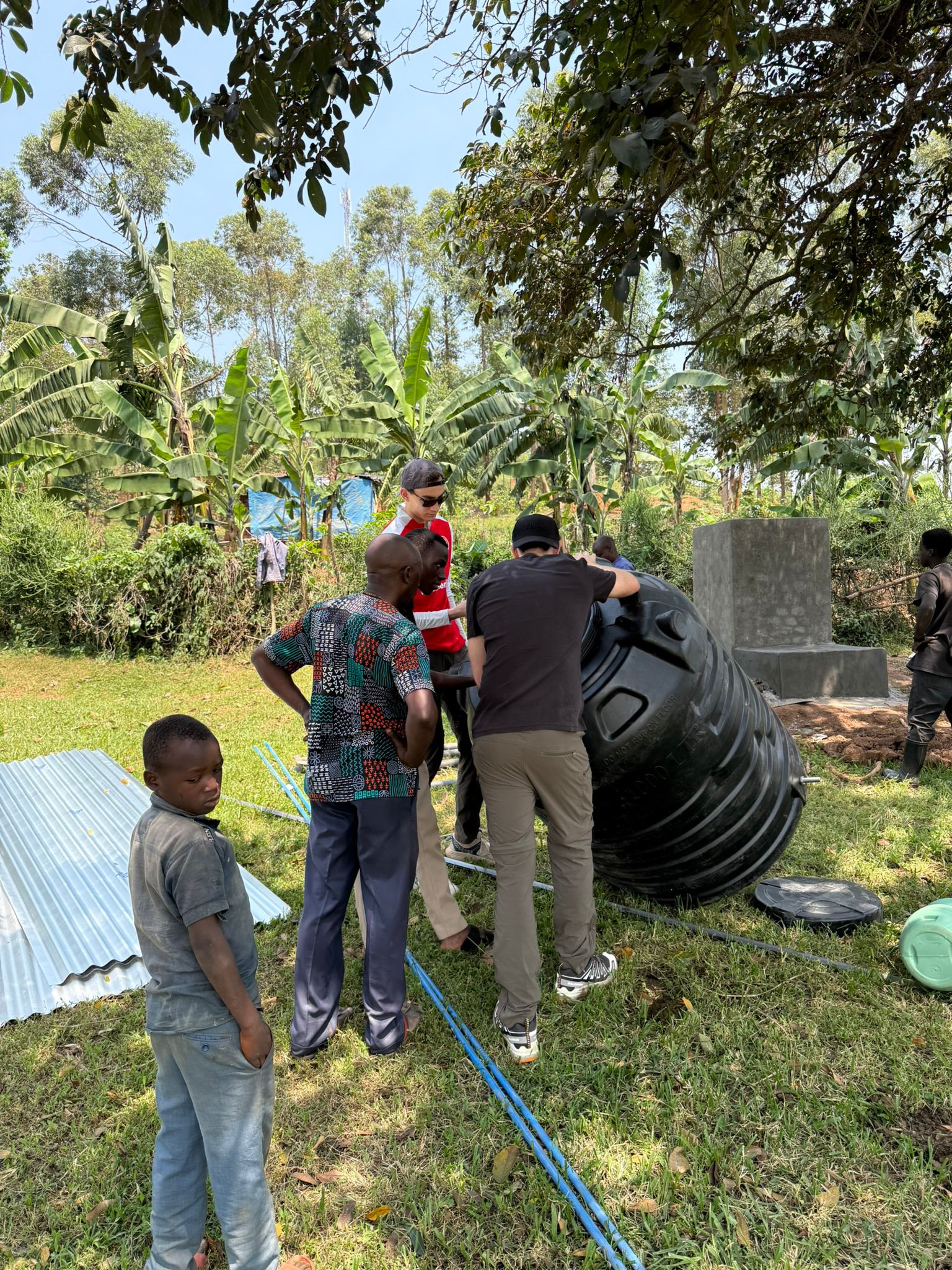
Building on this, we developed a customized system: A pipe would be connected directly to the existing faucet. The water would be pumped into a larger intermediate tank, which would need to be positioned significantly higher and on a stable foundation in order to build sufficient pressure in the PAUL and ensure a constant supply. From there, the water would flow through the filter by gravity and then be directed into a smaller tank with continuous flow so that it does not remain stagnant for long periods, especially in strong sunlight.
The next morning, we visited Vincent and Kole during their chess lessons for children. Six pairs of curious eyes looked us over, skeptical yet interested.
To be honest: We had to work hard not to be checkmated in just a few moves. That evening, we discussed Uganda’s economic prospects with some of Vincent’s friends, played basketball with the kids in the house, and finally returned to the hotel drenched in sweat to greet Flavian. The next day, our plans would become reality.
The next morning, on our way to Buwama, we picked up Viola—she had put us in touch with the school and works at St. Theresa School, which we also planned to visit toward the end of our stay.
Once again, our conversation with our Uber driver really struck a chord with us. Many of them had gone to college or completed vocational training, but the structure of the job market left them with few opportunities to gain a foothold in their actual fields of work. Our driver that day had a medical degree, but was earning significantly less working as an Uber driver than he did at the hospital.
A minor detail in everyday life—but a major structural issue.
After a police checkpoint—which, as it turned out, was far from the only one we would encounter on our entire journey—we finally arrived in Buwama. Brother Herman greeted us, and we first sat down in his office to explain the PAUL in detail once again and discuss together how maintenance and long-term responsibility could be organized.
After a brief tour of the school grounds—nestled in Uganda’s rolling countryside, amid open green spaces, free-range chickens, and the occasional cow—a surprise awaited us: all the necessary materials for the foundation had already been gathered, and two people were already hard at work. It was actually possible to lay the foundation of the structure that very same day—more or less exactly as we had planned together. We just had to hope the weather cooperated.
This time, we didn’t head back to Kampala; instead, we made a conscious decision to spend the night in the simple town of Buwama. “Blessing” accompanied us to our lodging and told us about his dreams for the future. Later, we celebrated Manchester United’s victory over Arsenal together with the locals before finally heading out into the warm, humid night.
The next morning, we headed straight out on a shopping trip through Buwama to pick up the remaining supplies at various small “hardware stores.” Shopping with locals had clear advantages—especially when it came to prices. To get enough cash, we drove with Brother Herman literally across the equator to another town so we could withdraw money there.
Once everything had finally been transported to the school, we were ready to begin. The foundation had dried, and step by step, the final structure took shape. To be fair, we had a mechanic on board who wanted to approach many things intuitively and based on gut feeling—which didn’t always align with the instructions. So I felt like I had to keep showing him the instructional video, which led to a thoroughly efficient balancing act between experience and method, adapted to local conditions.
Derrick from Makerere University provided us with invaluable support, particularly with translations and organizational coordination.
After a few final adjustments, the moment had arrived: the first drops flowed through the PAUL into the fresh water tank.
And suddenly he was standing there.
Working.
The relief was physically palpable.
Gemeinsam zapften wir die ersten Becher frisch aus dem PAUL und stießen mit einem Schluck sauberen Wassers auf diesen Moment an.
Für das restliche Konstrukt – ein schützendes Dach sowie eine Absicherung gegen direkte Sonneneinstrahlung und spielende Kinder – waren wir noch auf einen Schweißer angewiesen, der erst einige Tage später verfügbar sein würde. Daher beschlossen wir, noch einmal zurückzukehren, sobald alles vollständig fertiggestellt sein würde.
Bevor wir aufbrachen, verteilte Flavian einen größeren Koffer mit kleinen Mitbringseln an die anwesenden Kinder. Die Freude war unmittelbar und ehrlich.
The adults were happy because they knew they now had access to safe water. The children were simply happy to have us visit.
Was uns besonders berührte: Diese jungen Kinder spielten miteinander – ohne Smartphones, ohne permanente Ablenkung, ohne digitale Zwischenwelt. Sie beschäftigten sich miteinander und mit sich selbst. Eine Selbstverständlichkeit, die bei uns längst keine mehr ist.
Her satisfaction didn't seem forced. It was genuine.
Und genau das brachte uns zum Nachdenken – darüber, worum es eigentlich geht.
Since we had finished before dark, we decided on the spot to drive back to Kampala—but not before sharing a refreshing drink with Brother Herman and the team to celebrate this milestone.
We spent our last day in Flavian getting to know Kampala even better. With Isaac—our driver from the first day—and Vincent as our tour guide, we set out to learn more about the origins of Christianity in Uganda, the country’s various ethnic groups, and Uganda’s history.
The visit to the downtown market was particularly impressive.
Everything seemed to be happening all at once there. People, motorcycles, clothes, food, vendors’ voices, heat, smells—a constant stream of movement. The walk felt almost like a fever dream because all my senses were engaged at once. And we were probably a sight to behold for the locals, not just because of our background, but also because of my height (6’8”). Amid the sales pitches, I kept hearing the question of whether I was an American basketball player—or a “German highlander.”
One of the most memorable moments of our entire stay came the next day: a visit to the slum where Vincent grew up with his siblings to learn about the Kech Pii Ti project.
“Kech Pii Ti” roughly translates to: Hunger knows no age. It is an initiative that enables women to earn their own income by making handmade jewelry from recycled paper.
This project deserves far more attention than we can give it here—which is why we’ll be dedicating a separate, in-depth episode to it. Vincent, his family, and the women involved showed us how the jewelry is made. It was detailed, meticulous, and impressive.
Auch die sanitäre Situation vor Ort wurde sichtbar: eine kleine, veraltete Einrichtung ohne fließendes Wasser, die sich eine gesamte Straße teilen muss – ungefiltert und schwer zu verarbeiten. Gleichzeitig spielten hinter Vincents Unterkunft Kinder und zeigten uns ihre Spiele. Natürlich durften wir mitmachen.
Shortly thereafter, we said goodbye to Flavian, who had to head back to Germany—with a wealth of impressions that will likely take some time to process.
Another important event was our visit to the German Embassy in Kampala. The discussions about the political situation in Uganda seemed complex—partly intractable, partly structurally paralyzing. We continued to discuss the matter even hours later.
My personal view is that education remains one of the most effective long-term drivers of positive change. At the same time, it is clear that political sensitivities must be respected—especially with a view to long-term cooperation on the ground—which is why I have deliberately refrained from going into detail here.
Later on, we also visited St. Theresa School, which already has a water filter. We received a warm welcome, were greeted with a program schedule, and had the opportunity to engage in in-depth discussions with teachers, staff, and a young priest, who concluded the visit by giving us his blessing.
As in many schools, there are structural challenges here as well. What was particularly striking, however, was the strong commitment of the local staff—especially given the very limited government support. The existing water filter had not been cleaned properly according to the manual for quite some time. This was rectified, and it demonstrated once again how crucial personal guidance, training, and ongoing support are for the long-term sustainability of such a project.
Our last major trip took us back to St. Balikuddembe Primary School in Buwama. Together with Vincent and Kole, we stood in front of the completed project—this time with a roof and a fully integrated system.
The discussion between Vincent and Brother Herman about their future collaboration was particularly valuable. Drawing on his own experiences, he understands the local context from a perspective that is essential for sustainable projects.
Our final conversations before departure were reflective, but above all forward-looking.
How can we ensure that water, hygiene, and education remain priorities in the long term?
What might a form of collaboration look like that has a structural rather than a one-off impact?
We continue to work on these very issues, regularly via Teams, across continents. Our goal is to establish a sustainable culture of awareness regarding water, hygiene, and education in various schools and to reach as many children as possible.
Shortly after we returned to Germany, we received photos and videos from Brother Herman showing children using the new water system.
It was a moment of validation, but certainly not the end.
I’m looking forward to returning to Buwama. Hopefully, this time while school is in session.
Special thanks go to Vincent—for his support, his openness, and his long-term commitment. His dream of creating learning spaces for children in slums through tutoring and safe spaces of his own deserves every bit of support.
This isn't goodbye. We stay in regular contact, are already planning the next Impact Project in Uganda, and continue to work hand in hand.
Because a filter is just the beginning. What comes of it is a shared responsibility.
~ Anthony


0 Comments